

Best golf hats for sun protection in 2026
Best overall: a wide-brim hat with a verified UPF rating. Best for exposed neck coverage: a neck-flap hat. Best for golfers who prefer a familiar cap shape: a rope cap, paired with protection for uncovered skin. The best golf hats for sun protection in 2026 earn their place through coverage, not just a good-looking front panel.
- For golf hats for sun protection, choose verified UPF fabric and coverage before styling.
- A wide-brim golf hat shades more exposed areas than a front-brim cap.
- Mac Caddy rope hats suit golfers who prefer cap styling; no UPF rating is provided in the supplied specifications.
- Use broad-spectrum SPF 30 or higher on exposed skin; a golf hat does not replace sunscreen.
Why this matters
A cap shades the front of your face, but your ears and neck are still in the game. If sun protection drives your purchase, judge the shape before the embroidery.
The American Academy of Dermatology recommends a wide-brimmed hat and broad-spectrum, water-resistant sunscreen with SPF 30 or higher. That advice applies to your 2026 golf wardrobe, whether you walk, ride, or spend an afternoon on the practice green.
For the styling side, the golf rope hats guide covers that particular silhouette. Here, coverage gets top billing.
What makes the best golf hats for sun protection?
Use these criteria before deciding which hat deserves a spot beside your glove:
- Coverage: Look at the face, ears, and back of the neck separately. A shaded forehead does not mean everything else is covered.
- Verified UPF: Choose an explicitly stated ultraviolet protection factor rather than treating “performance” or “sun hat” as a rating.
- Brim shape: A brim extending around the head provides coverage a front-only bill cannot.
- Secure fit: Check that the hat stays comfortable and stable when you address the ball, turn, and finish your swing.
- Wearable construction: Inspect ventilation, the sweatband, seams, and care instructions. A hat you remove halfway through the round stops doing its job.
UPF describes protection through fabric; SPF describes sunscreen protection. UPF 50 fabric allows one-fiftieth of ultraviolet radiation through under its test conditions, equivalent to blocking 98%. That rating does not protect skin beyond the fabric’s coverage.
Golf sun hats at a glance
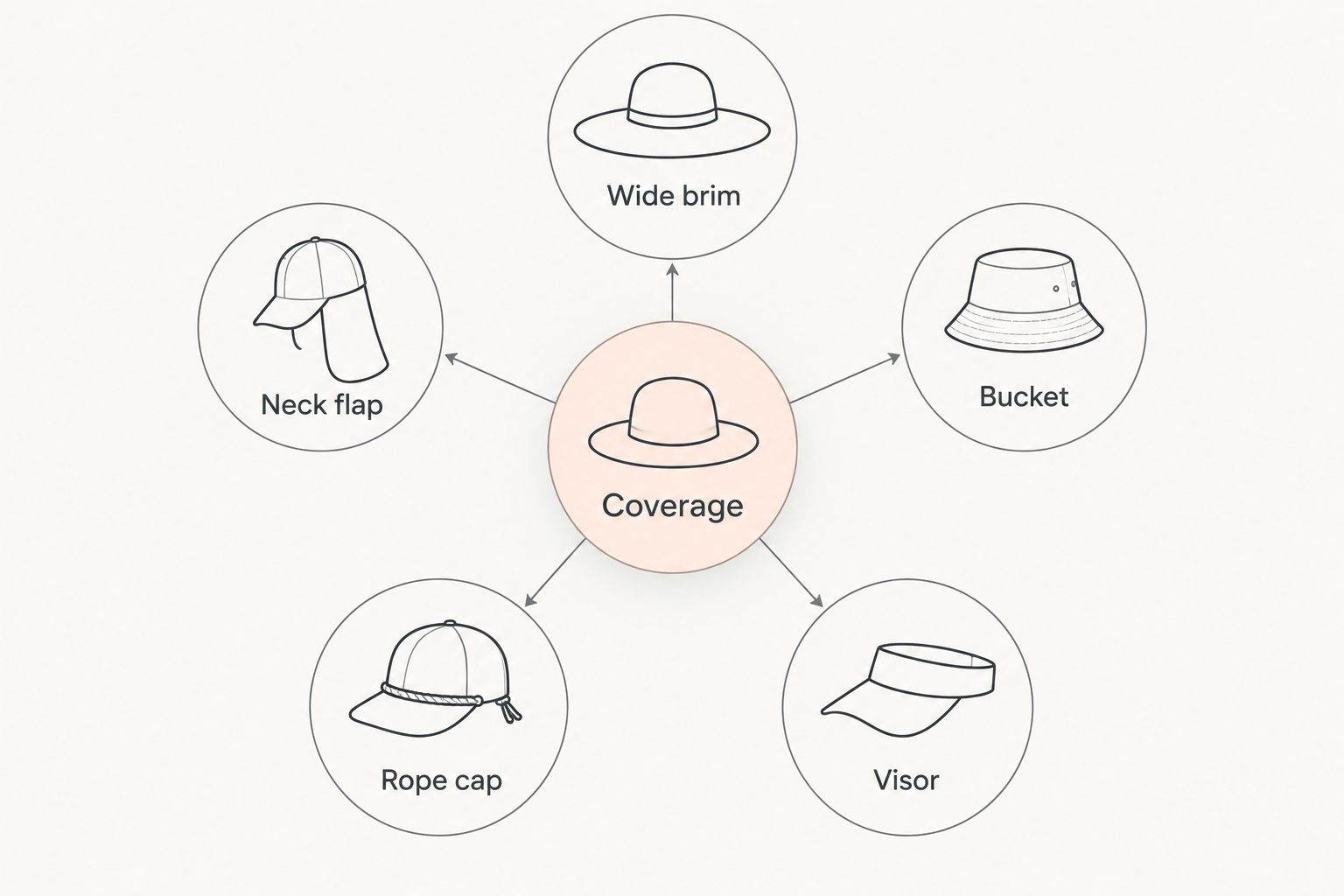
These are hat categories, not tested product winners. The order prioritizes coverage, then the compromises involved in wearing each shape during golf.
| Hat type | Best for | Standout benefit | Key limitation |
|---|---|---|---|
| Wide brim | Coverage-first golfers | Brim extends around the head | Wider profile needs a swing and wind check |
| Neck flap | Protecting the back of the neck | Fabric extends below the rear crown | Flap does not automatically shade the face or ears |
| Bucket | Golfers wanting an all-around brim | Brim surrounds the crown | Short bucket brims leave more skin exposed |
| Rope cap | Golfers who prefer cap styling | Front bill shades part of the face | Ears and neck remain uncovered |
| Visor | Golfers prioritizing an open crown | Front shade without a covered crown | Leaves the top of the head exposed |
Coverage depends on the actual dimensions and fit of the hat, not its category name alone. A tiny brim does not become useful sun coverage because the label calls it a bucket.
1. Wide-brim hat: best for coverage-first golfers
A wide-brim hat puts shade around your head rather than only in front of it. Choose one with a stated UPF rating and a brim that meaningfully covers your face, ears, and neck.
For a 2026 sun-first shortlist, this is the default. The Skin Cancer Foundation recommends a brim of at least 3 inches all around; treat that as a shopping criterion, not a guarantee that every angle of exposed skin stays shaded.
Best for: Golfers who want sun coverage to lead the decision.
What works: The surrounding brim addresses areas a baseball-style cap leaves uncovered. It also lets you choose protection without relying on a separate neck accessory.
What to check: Look down at an imaginary ball, rotate through your finish, and check your sightline. A brim that interferes with your normal setup is the wrong fit, even if its coverage looks excellent on a hanger.
Wind deserves a check, too. Try any retention adjustment before heading out, and make sure it does not distract you while swinging.
Verdict: Buy a verified-UPF wide-brim hat if sun protection is your main goal.
2. Neck-flap hat: best for covering the back of your neck
A neck-flap hat adds fabric behind the crown to cover the back of the neck. It addresses a clear weakness of the ordinary cap: the gap between the rear of the hat and your shirt collar.
Do not assume that the flap solves everything. Inspect the front brim and side coverage separately, because a covered neck can still come with exposed ears.
Best for: Golfers whose main coverage gap is the back of the neck.
What works: The flap puts fabric over an area a front bill cannot shade. A design that stays in position gives you a physical layer of coverage rather than leaving that area entirely to sunscreen.
What to check: Turn your head both ways and bend into your putting stance. Confirm that the flap stays over your neck without bunching against your collar or becoming a distraction.
The trade-off is straightforward: more fabric around your neck, and a more functional appearance. If that is the area you want covered, the compromise has a purpose.
Verdict: Buy for neck coverage; check the face and ears before calling the job finished.
3. Bucket hat: best for an all-around brim in a casual shape
A bucket hat surrounds the crown with a brim, but brim widths vary. Pick the actual coverage, not the bucket label.
A short fashion bucket and a broad sun-focused bucket do not offer the same shaded area. For your 2026 golf kit, inspect the brim measurement and stated UPF rating before getting attached to the look.
Best for: Golfers who want an all-around brim with casual styling.
What works: The surrounding brim offers a different coverage pattern from a cap. The shape also gives golfers another option when a traditional wide-brim silhouette is not their preference.
What to check: Look at whether the brim holds its position or folds away from the areas you want shaded. Check the view at address, especially if the front edge droops toward your eyes.
Its limitation is the category’s inconsistency: “bucket hat” tells you the general shape, not the UV rating or the amount of neck coverage. Both need their own check.
Verdict: Buy a bucket with useful brim coverage and a verified rating; skip the assumption that every bucket is a sun hat.
4. Rope cap: best for golfers who prefer cap styling
A rope cap keeps the familiar front-bill silhouette and adds the rope detail that gives the style its name. It belongs in this guide as a style-first alternative, not as the coverage winner.
Mac Caddy golf hats suit golfers who want rope-cap styling rather than an all-around sun brim. The supplied product descriptions identify embroidered caddy logos, but do not establish UPF ratings, brim measurements, or fabric UV test results.
Two relevant options are the Mac Caddy Performance Rope Hat – Black and Mac Caddy Performance Rope Hat – Navy Golf Hat. Neither earns a sun-protection advantage over the other from the supplied specifications.
Best for: Golfers who prefer a cap and will protect the exposed areas separately.
What works: The front bill provides shade to part of the face, and the cap silhouette fits the preference of golfers who do not want a surrounding brim.
What to check: Your ears and the back of your neck remain uncovered. Do not read “performance” in a product name as proof of a particular UV rating, sweat-management feature, or cooling result.
Verdict: Buy for cap styling; skip this shape if your priority is all-around coverage.


5. Visor: best for golfers who want an open crown
A visor provides front shade without covering the top of your head. That makes its central compromise impossible to miss: it is not a complete head-covering option.
Choose a visor because you prefer the open-crown feel, not because it outperforms a full hat on coverage. Exposed scalp needs its own protection.
Best for: Golfers who specifically prefer an open crown and understand the coverage gap.
What works: The front brim shades part of the face without fabric over the crown. The shape gives you an alternative if a covered crown is uncomfortable.
What to check: Your scalp, ears, and neck are not covered by the visor. Hair should not be treated as a verified UPF barrier, and a wide front bill does not change what is missing above and behind it.
For a purchase driven primarily by sun protection, the coverage trade-off moves the visor to the bottom of this list.
Verdict: Skip as your default sun-protection hat; choose it only with a separate plan for exposed skin.
How these hat types rank
The 2026 ranking follows the criteria above: coverage comes first, followed by verifiable fabric protection, usable brim shape, and a fit you will keep wearing. It is a category buying guide, not a claim of hands-on product testing.
No named cap receives an assumed UPF rating. No color receives an automatic UV-protection win. The information needed for those comparisons is a stated specification or test result, not a product photograph.
Which golf sun hat should you choose?
Choose a verified-UPF wide-brim hat if you are undecided. It is the strongest starting point here because the brim extends around the head instead of stopping at the temples.
Choose a neck-flap design when rear-neck coverage drives the purchase. Choose a bucket only after checking its actual brim, and choose a rope cap when familiar styling matters more than surrounding coverage.
Before removing the tags, run this practical check:
- Address: Look down comfortably without the brim blocking your view.
- Turn: Rotate your head and check whether the hat shifts.
- Finish: Make a slow practice swing and check for interference.
- Inspect: Identify every patch of skin the hat leaves uncovered.
That last step matters more than matching the hat to your shoes. Build your sunscreen and clothing choices around those uncovered areas.
FAQ
What's the best golf hat for sun protection in 2026?
A wide-brim hat with a verified UPF rating is the best starting point for coverage-first golfers. Check that the brim shades your face, ears, and neck, and use sunscreen on exposed skin.
Is a bucket hat better than a baseball cap for golf sun protection?
A bucket hat with a sufficiently wide surrounding brim covers areas a front-bill cap leaves exposed. The actual brim dimensions and fabric rating matter more than the bucket label.
Do Mac Caddy golf hats have a UPF rating?
The supplied Mac Caddy golf hat specifications do not state a UPF rating. Do not treat the word performance as a substitute for a verified fabric protection rating.
How wide should the brim on a golf sun hat be?
The Skin Cancer Foundation recommends a brim of at least 3 inches all around for sun protection. Check your view at address and make sure the brim does not interfere with your swing.
Do I still need sunscreen if I wear a golf hat?
Yes, exposed skin still needs sunscreen when you wear a golf hat. The American Academy of Dermatology recommends broad-spectrum, water-resistant SPF 30 or higher, reapplied every 2 hours outdoors and after swimming or sweating.
Is a white golf hat automatically better for UV protection?
No, color alone does not establish a golf hat's UV protection. Compare stated UPF ratings, construction, and coverage rather than assuming one color wins.
Is a visor enough for a sunny golf round?
A visor alone leaves the scalp, ears, and neck uncovered. Choose a full hat when head coverage is the priority, and protect any skin that remains exposed.
One last thing
A UPF label describes the fabric, not an invisible shield around your head. The uncovered patch behind your ear does not inherit the rating on your hat.
Make that your final 2026 buying check: identify what the hat covers, then protect what it does not. Pick your style after that. Get the Juice.