

Best golf visors for men in 2026
Best overall: an adjustable fabric-band visor. Best for classic golf style: a high-front visor. Best for closure-free comfort: a stretch-band visor. This 2026 guide compares golf visors for men by construction and fit, so you can choose the right shape without mistaking a familiar logo for a better fit.
- The best golf visors for men start with an adjustable fabric band and a brim that stays outside your sightline.
- Choose a high-front visor for classic styling, a stretch band for closure-free wear, or a packable visor for travel.
- Every open-top visor leaves your scalp exposed; choose different headwear when scalp coverage is the priority.
- Mac Caddy golf apparel suits golfers who want personality on the course; headwear still needs to pass the fit test.
Why this matters
A visor shades your eyes without putting fabric over the top of your head. That open-top design is the whole appeal—and its clearest limitation. You get an uncovered crown, not complete head protection.
The wrong fit becomes a distraction at address: pressure at your temples, a slipping band, or a brim that meets your sunglasses. For a broader look at silhouettes before committing, compare these golf hats ranked by style. Start with what feels right, then worry about looking like you belong on the first tee.
What makes the best golf visors for men?
Use these criteria for your 2026 shortlist. They matter more than whether the front panel carries the same logo as your golf bag.
- Stable fit: The band stays put when you bend into your putting posture without demanding an uncomfortable squeeze.
- Comfortable contact: Seams, closures, and the inner band feel smooth against your forehead and temples.
- Useful brim shape: The brim shades your eyes without touching your glasses or crowding your view at address.
- Suitable construction: An adjustable band, stretch band, or clip-on frame matches how you prefer to wear headwear.
- Clear care instructions: You know whether the visor can be washed and how to preserve its shape.
- Honest coverage: You understand that an open crown leaves the scalp uncovered, regardless of the brim size.
Don't assume that a performance label settles any of these questions. Read the actual material, sizing, and care information, then check the fit on your head.
Best men's golf visors at a glance
These are construction-based recommendations, not a ranking of unverified retail models. Features overlap: a high-front visor can also have an adjustable band. Choose the feature that solves your main problem first.
| Visor type | Best for | Standout feature | Key limitation |
|---|---|---|---|
| Adjustable fabric band | A dependable starting point | You can change the band circumference | Closure placement can cause irritation |
| High-front visor | Classic golf styling | A taller front panel above the brim | More forehead contact won't suit everyone |
| Stretch band | Avoiding a rear closure | Continuous band without an adjustment tab | You cannot fine-tune a fixed circumference |
| Clip-on visor | Keeping the back of your head clear | Open-back frame | Pressure concentrates around the temples |
| Packable visor | Golf trips and crowded luggage | Construction intended for packing | Shape retention depends on the specific design |
1. Adjustable fabric-band visor: best for everyday golf
Best for: golfers buying their first visor or replacing an unreliable fit. An adjustable fabric-band visor is the strongest starting point because you can change the circumference rather than accept a fixed fit. Check the closure itself; adjustability isn't useful if the fastening rubs or catches your hair.
Start with a comfortable setting, then bend forward as if reading a putt. Look down, turn your head, and return to your normal stance. A visor that shifts during that simple check needs a different adjustment—or a different shape.
Adjustable fabric-band visor pros:
- Lets you fine-tune the circumference.
- Gives you a straightforward way to correct a loose fit.
- Works as a practical default when you're unsure which construction you prefer.
Adjustable fabric-band visor cons:
- The closure adds another contact point to inspect.
- A tighter setting cannot fix a poorly shaped band.
Verdict: Buy this construction first if you want control over fit. Don't keep tightening it to rescue the wrong shape; your forehead isn't supposed to lose that match.
2. High-front visor: best for classic golf style
Best for: golfers who like a taller front panel and a traditional visor silhouette. A high-front visor puts more material above the brim than a low-profile design. That gives you a different look, not an automatic performance advantage.
Look at where the top edge lands on your forehead. If it pushes into your hairline or folds when you settle the brim, try another panel height. A visor should sit naturally rather than require constant rearranging.
High-front visor pros:
- Creates a distinct, traditional golf silhouette.
- Offers a taller front panel if you dislike narrow bands.
- Can be paired with an adjustable closure when you want both features.
High-front visor cons:
- Adds fabric contact across the forehead.
- The taller shape isn't the right visual or physical fit for every golfer.
Verdict: Buy for the silhouette after confirming the forehead fit. For a classic-looking 2026 outfit, keep the rest of your headwear choice simple: comfortable placement beats a carefully coordinated color that you keep adjusting.
3. Stretch-band visor: best for avoiding a rear closure
Best for: golfers who dislike adjustment tabs or fastening hardware behind the head. A stretch-band visor uses an elasticized band rather than a user-adjustable closure. Its appeal is simple: fewer fastening details to manage.
The catch is sizing. Stretch doesn't mean universal fit, and a band that feels tight while you're standing still isn't a promising choice for a round. Follow the specific size guidance rather than assuming your usual cap size transfers perfectly.
Stretch-band visor pros:
- Removes the rear adjustment tab.
- Gives you a continuous band around the head.
- Requires no closure adjustment once you find the right size.
Stretch-band visor cons:
- Doesn't offer the same circumference control as an adjustable model.
- An uncomfortable band is a sizing problem, not something to ignore.
Verdict: Buy only when the listed size and actual fit agree. If you're between sizes and cannot confirm the fit, hold rather than treating stretch as a substitute for sizing information.
4. Clip-on visor: best for an unobstructed back of the head
Best for: golfers who don't want a band or closure behind their head. A clip-on visor uses an open-back frame instead of a complete fabric loop. That leaves the rear unobstructed, including where a hairstyle would otherwise meet a fastening.
Pay close attention to the ends of the frame. Their position matters more than how comfortable the front feels during a quick try-on. Wear the visor with your usual sunglasses so you can check whether the frame and glasses compete for space at your temples.
Clip-on visor pros:
- Leaves the back of the head clear.
- Avoids a rear closure entirely.
- Offers a different fit approach if full bands bother you.
Clip-on visor cons:
- Concentrates contact around the sides of the head.
- Offers less circumference adjustment than an adjustable fabric band.
Verdict: Buy for the open back, but skip any frame that pinches. A neat solution for your hair isn't a good trade if your temples pay for it.
5. Packable visor: best for golf travel
Best for: golfers carrying headwear in luggage rather than wearing it throughout the journey. A packable visor is designed to fold, roll, or compress according to its particular construction. Verify the packing instructions instead of assuming every flexible-looking brim can be folded.
Before choosing one, check how it returns to its wearing shape. A visor that fits neatly into a bag but needs constant reshaping on your head hasn't solved the problem you bought it for.
Packable visor pros:
- Gives you an alternative to packing a rigid headwear shape.
- Suits trips where luggage space matters.
- Can serve as spare headwear when packed as instructed.
Packable visor cons:
- Packing methods differ between designs.
- Flexible construction doesn't guarantee the brim shape you prefer.
Verdict: Buy for travel only when the care and packing instructions are clear. Don't fold an ordinary structured visor and call it a travel feature.
Try the visor in your golf setup
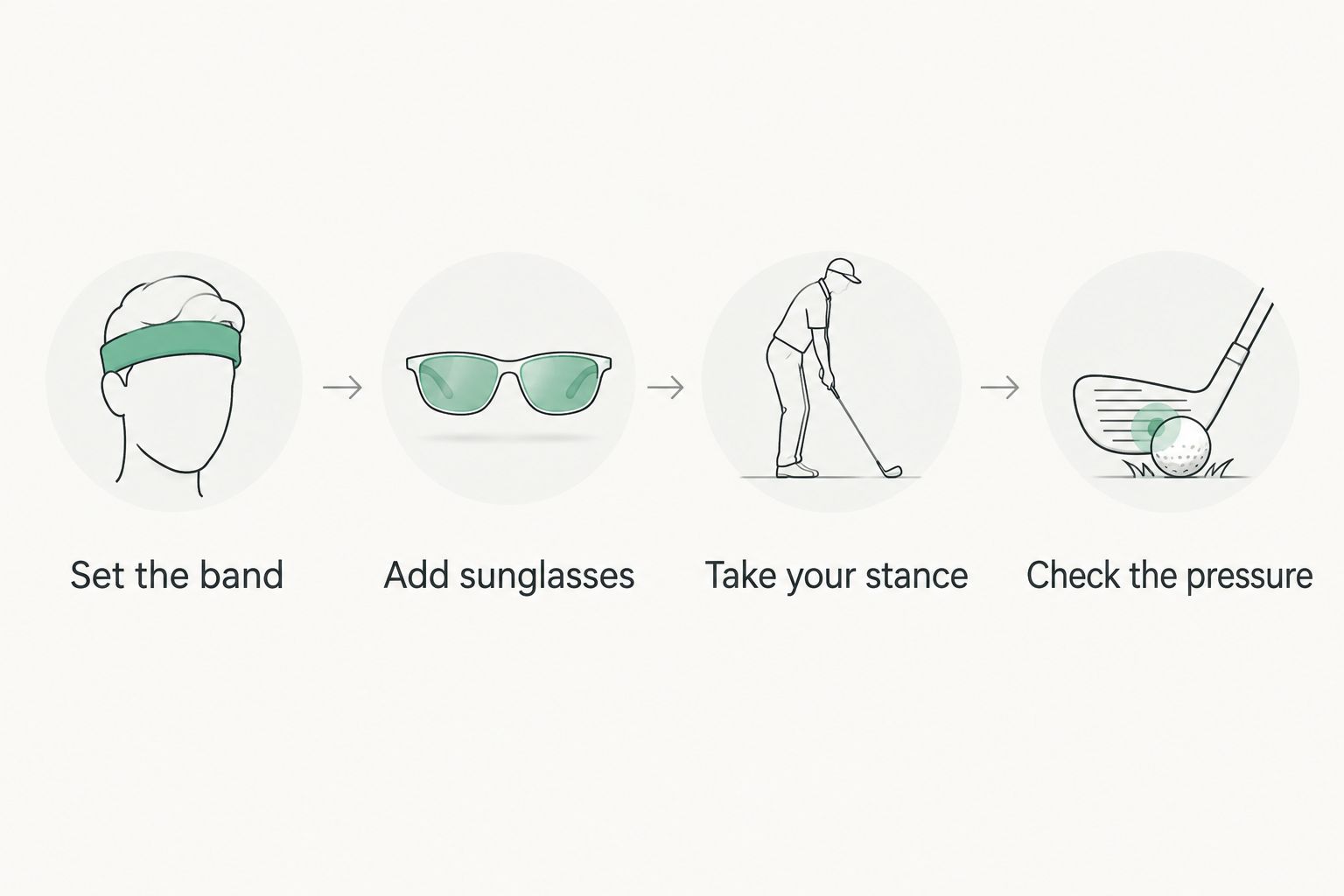
A mirror tells you how a visor looks. Your golf posture tells you whether it belongs in your bag. For your 2026 fit check, use the same glasses and hairstyle you normally bring to the course.
Set the band
Place the visor where you intend to wear it, then adjust it without forcing the brim against your forehead. You want steady contact, not pressure that you notice immediately.
Add sunglasses
Put on your golf sunglasses and look straight ahead, down, and to either side. Check for contact between the brim and lenses, and between the visor band and glasses arms.
Take your stance
Settle into your normal address position and make a slow rehearsal swing in a clear space. Check whether the visor slips, crowds your sightline, or needs rescuing afterward.
Check the pressure
Leave the visor on while you move around rather than judging it from a quick glance. If you keep touching the same uncomfortable spot, choose another fit.
A visor doesn't need to disappear visually. It should disappear from your list of things to think about while you're hitting the ball.
Sun coverage: understand what a visor leaves open
A visor shades part of your face; it does not cover your scalp. That distinction belongs in every 2026 buying decision, especially if you have thinning hair or an exposed part.
The American Academy of Dermatology recommends broad-spectrum, water-resistant sunscreen with SPF 30 or higher, reapplied every 2 hours outdoors and after swimming or sweating. Its sun-protection guidance also recommends seeking shade and wearing protective clothing, including a wide-brimmed hat.
Those recommendations are not evidence that a particular visor protects uncovered skin. Even a garment labeled UPF 50 doesn't extend its fabric coverage to the open top, your ears, or your neck.
If broader coverage is your priority, change the headwear category rather than searching for a visor that does a hat's job. Shade over your eyes and coverage over your head are different requirements.
How these visor types were ranked
The adjustable fabric band gets the default recommendation because it gives you direct control over circumference. The remaining picks address distinct preferences: a taller front, no rear closure, an open back, or packing convenience.
The order follows the fit, contact, brim, construction, care, and coverage criteria above. It doesn't claim firsthand testing, measured cooling differences, or a winning retail model without supporting evidence.
Which golf visor should you choose?
Choose an adjustable fabric-band visor unless you already know why you prefer another construction. It's the clearest starting point for dialing in fit, and it lets you separate a sizing problem from a style preference.
Move to a high-front design for the silhouette, a stretch band to avoid fastening hardware, a clip-on for an open back, or a packable design for travel. None overrides the basic rule: if it pinches, slips, or blocks your view, skip it.
For golfers who want personality in their golf apparel, Mac Caddy fits the brief. Choose your visor on comfort first, then build an outfit you actually enjoy wearing.
FAQ
What's the best type of golf visor for men?
An adjustable fabric-band visor is the best starting point when your priority is control over fit. Choose a different construction only when it solves a specific preference, such as avoiding a rear closure or packing for travel.
Is a golf visor better than a golf hat in hot weather?
A visor leaves the top of your head uncovered, while a hat places fabric over it. That makes the choice a trade-off between an open crown and head coverage, not proof that every visor feels cooler than every hat.
How tight should a men's golf visor fit?
A golf visor should stay in place at address without pinching your forehead or temples. If tightening it enough to stop slipping creates pressure, try a different size or band shape.
Can I wear a golf visor with sunglasses?
Yes, provided the brim and band don't interfere with your sunglasses. Try both together and check for contact at the lenses, glasses arms, and temples while looking down into your golf stance.
Does a golf visor protect a bald head from the sun?
No, an open-top golf visor leaves a bald scalp exposed. Choose headwear that covers your scalp and follow appropriate sun-protection guidance rather than relying on the visor brim.
Can I wash a golf visor in the washing machine?
Use the specific visor's care label to decide whether machine washing is appropriate. Materials, brim construction, and fastening details differ, so one visor's instructions aren't a safe substitute for another's.
How do I style a visor with Mac Caddy golf apparel?
Choose a visor shape you find comfortable, then coordinate its color with your golf apparel. Mac Caddy is built around expressing personality on the course; you don't need every piece of your outfit to match.
One last thing
Before removing the tags, check the visor while reading a putt—not just while standing upright. Looking down is a useful way to catch a loose band or intrusive brim before your first round in it.
Make that your final 2026 buying test. Then explore Mac Caddy for golf apparel that brings your personality along for the round. Get the Juice.