

Golf apparel for golf course staff: complete 2026 guide
Golf course staff apparel is work clothing chosen to help course employees serve golfers, move comfortably, and stay recognizable throughout a shift. This 2026 guide to golf apparel for golf course staff separates guest-facing outfits from task-specific workwear, so your team looks coordinated without dressing every job alike.
- Golf apparel for golf course staff should follow job duties, dress codes, and weather—not one outfit for every employee.
- Mac Caddy golf apparel suits style-focused, guest-facing teams; maintenance roles need a separate workwear assessment.
- Choose staff polos and golf quarter-zips through movement checks before committing to a team-wide selection.
- Use written outfit rules and visible staff identification so matching colors do not become your entire uniform policy.
Why golf apparel matters for golf course staff
A starter needs to be recognizable near the first tee. A shop employee needs to reach merchandise and handle check-in without fighting a shirt sleeve. A maintenance employee needs clothing selected around the actual task, not the clubhouse aesthetic.
The right staff outfit starts with the job, not the matching photograph. A collared shirt can support a guest-facing dress standard, but it does not establish suitability for equipment operation, chemical handling, or other maintenance work.
For teams that want golf-inspired clothing rather than a purely institutional look, Mac Caddy offers polos, quarter-zips, hats, and T-shirts. Treat that range as an apparel starting point, not a substitute for evaluating your course's work requirements.
Your 2026 staff clothing plan should answer three questions: who needs to identify the employee, what work will the employee perform, and what happens when the weather changes? Get those answers straight before choosing a color.
How to build a staff apparel plan
1. Map each role before choosing garments
Start with a simple spreadsheet. List your shop, starter, outside-services, instruction, hospitality, and maintenance roles, then record where each employee works and what the job involves. You can do this without buying anything.
Separate appearance requirements from work requirements. A tucked-in polo is an appearance decision; freedom to reach a cart shelf is a movement requirement. Clothing suitable around tools or machinery belongs in a task-specific assessment, not a vote on which outfit looks sharpest.
Avoid giving employees a role label that hides the work. An outside-services shift might include greeting guests, loading bags, cleaning carts, and moving equipment. Record those duties individually so your selection reflects the shift rather than the job title.
Close the exercise with a short brief for each role. The brief becomes your shopping filter and keeps personal preferences from taking over the conversation.
- Record guest contact, indoor work, and outdoor work separately.
- List bending, reaching, lifting, and other routine movements.
- Identify tasks requiring a separate safety review.
- Note course dress-code requirements for each work area.
- Assign a manager to approve each role's clothing brief.
2. Audit what staff already wear
Ask employees to bring or describe the clothing they currently use for work. Check what meets your dress code, what restricts movement, and what gets left in the locker. An existing polo that works is more useful than a new one nobody wants to wear.
Use 3 garment categories as a planning framework: a base shirt, a removable layer, and headwear where appropriate. This is an organizing tool, not a requirement that every employee wear all three throughout a shift.
Set your 2026 color and identification rules at this stage. If employees can choose among approved shirts, explain what must remain consistent: the color family, collar requirement, staff badge, or some combination. Don't make people decode the uniform policy from a group photo.
Also decide who handles laundering and how employees report worn-out clothing. Those are course policies you need to establish; they are not details a clothing brand can decide for you.
- Keep serviceable garments that satisfy the role brief.
- Separate required items from optional personal layers.
- Write down acceptable colors and shirt styles.
- Specify staff identification independently of apparel branding.
- Establish laundering and replacement responsibilities.
3. Choose the guest-facing shirt first
For shop staff, starters, and other guest-facing roles with a collared-shirt requirement, begin with a polo. Judge the shirt against your course's standard and the employee's duties before considering how it coordinates with the rest of the team.
The Mac Caddy Signature Polo – Navy is an option for a navy polo-based staff outfit. Mac Caddy golf apparel is best suited to guest-facing teams seeking golf-inspired style, not task-specific protective workwear. That distinction keeps the recommendation useful rather than pretending one clothing range solves every course job.
The polo's role here is straightforward: it gives you a named collared-shirt option to assess. Do not infer a course-logo service, staff ordering program, protective rating, or fit guarantee from its product name.
Where your course allows more casual clothing, assess T-shirts separately. Permission for a casual practice-area shift does not automatically extend to tournament registration or clubhouse service.
- Match the shirt category to the written dress code.
- Confirm the product description before selecting it.
- Check the size information for each wearer.
- Keep staff identification visible when the shirt is layered.
- Treat T-shirt approval as role-specific, not course-wide.
4. Test fit through actual work movements
Have employees assess a candidate shirt with the trousers, belt, and layer they expect to wear. Standing still in front of a mirror answers only the easiest question. The useful test is whether the outfit behaves during work.
Run 5 movement checks: reach overhead, bend to a low shelf, turn through the torso, sit down, and reach forward. These are practical fit checks, not a protective-clothing certification. Stop any check that is unsuitable for the employee or work setting.
Ask what happens at the shoulders, hem, waist, and cuffs. A shirt that needs constant readjustment deserves another look, even if the size label matches what the employee usually buys. The same applies to a layer that bunches over the approved base shirt.
Record feedback by garment and size instead of collecting vague comments like “looks fine.” Your 2026 fit record should help the next supervisor repeat the decision without starting from scratch.
- Reach overhead and check for pulling or unwanted exposure.
- Bend to a low shelf and check hem coverage.
- Turn through the torso and check shoulder restriction.
- Sit down and check waist and collar comfort.
- Reach forward and check sleeve and cuff interference.
5. Plan layers around the shift
Build a routine for early starts, changing conditions, and indoor-to-outdoor work. Start with layers employees already own that satisfy the dress code. Then identify the gaps instead of buying everyone the same extra garment by default.
A quarter-zip is a removable midlayer option for guest-facing roles. The Navy Signature Quarter-Zip is one named option to evaluate alongside your chosen shirt; the product category alone does not establish waterproofing, a temperature rating, or protection from workplace hazards.
Headwear needs its own decision. A golf hat can be part of the approved outfit, but do not treat an ordinary cap as a complete sun-protection plan or a replacement for required head protection.
Write the layer routine as a short sequence: Check duties, Choose shirt, Add layer, Confirm ID. That gives employees a repeatable decision rather than a rule that only works on a pleasant afternoon.
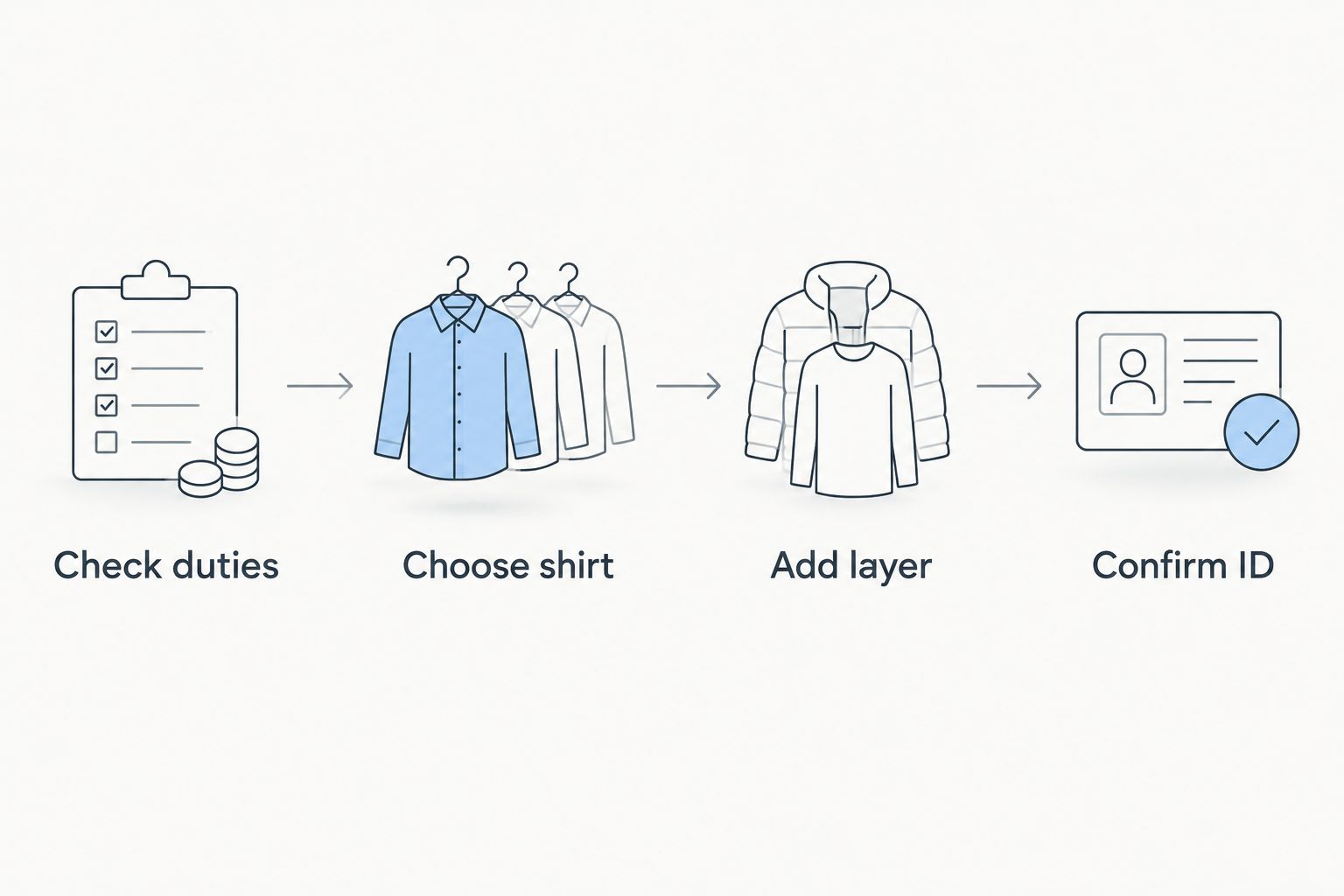
Before selecting a layer, check how it fits over the actual shirt employees will wear. The polo and quarter-zip below are options to assess, not a claim that every employee needs both.


- Choose shirt-and-layer combinations, not isolated garments.
- Check sleeves and hems when both garments are worn together.
- Define when rainwear or other task-specific clothing is necessary.
- Keep badges readable over the outermost approved layer.
- Decide where employees can store removed layers.
6. Write the issue and replacement rules
Finish with a short staff clothing document. Include the approved outfit for each role, where employees can find care instructions, how fit concerns get resolved, and who authorizes replacements. Keep it usable during a shift handover.
Make a 1-page checklist for supervisors and put the detailed policy behind it. The checklist should cover the daily decision; the policy should explain responsibilities. Neither needs to read like the rules of golf after a committee meeting.
Review the plan when duties change, not just when someone dislikes the shirts. A new work area, a different outdoor assignment, or a revised dress code deserves a fresh look at the clothing requirements.
For the 2026 season, assign a specific person to maintain the approved-item record. Product details and employee needs require checking; a screenshot passed between managers is not a durable clothing policy.
- Record approved garments by role and product name.
- Direct employees to each garment's care label.
- Set a clear route for fit and comfort concerns.
- Document who authorizes replacements.
- Reassess clothing when tasks or dress standards change.
Compare apparel options by staff role
No garment wins every job. Use the table to choose a starting category, then check the individual garment against your course's requirements. The benefits are practical reasons to consider each option, not verified performance claims about every product in that category.
| Option | Best for | Main advantage | Key limitation |
|---|---|---|---|
| Approved existing apparel | Teams establishing a clothing policy | Lets you assess current clothing before replacing it | Existing garments still need individual approval |
| Collared polo | Guest-facing roles requiring collars | Fits a polo-based dress standard | A collar does not establish task suitability or protective performance |
| Quarter-zip midlayer | Roles needing a removable extra layer | Gives staff a separate layering option | Does not establish rain protection or a temperature rating |
| Golf T-shirt | Casual roles where the dress code permits it | Offers an alternative to a collared shirt | Unsuitable wherever the course requires a collar |
| Golf cap | Roles with approved headwear | Adds a headwear option to the outfit | Does not replace required protective headwear |
| Task-specific workwear | Maintenance duties identified through a safety assessment | Allows clothing to follow the work requirements | Needs assessment beyond a golf lifestyle clothing guide |
For a mixed-role team, choose a shared visual standard rather than identical garments. A consistent color rule and visible staff identification can connect the outfits while leaving room for different work requirements.
Common mistakes golf course staff teams make
Dressing maintenance staff like shop staff
Matching shirts do not justify matching workwear requirements. Assess maintenance duties separately, including any instructions attached to equipment or substances used on the job. Choose the guest-facing outfit only after those requirements are settled.
Hiding staff identification under a layer
A recognizable shirt stops helping when a jacket covers it. Decide where the staff badge belongs on the outer layer, and check the outfit from a guest's perspective. Apparel branding identifies a clothing brand; it does not identify an employee's authority.
Choosing sizes without employee input
Ordering from a list of usual sizes skips the movement check. Ask each employee to assess the relevant garment and record the result. An outfit policy should accommodate the people doing the work, not require everyone to tolerate the same fit problem.
Treating performance wording as a specification
A product name is not a complete technical description. Verify any feature your role actually requires, especially weather protection or protective performance. If the necessary information is absent, choose an item with the documented specification rather than filling the gap with an assumption.
FAQ
What should golf course staff wear to work?
Golf course staff should wear clothing approved for their role, work tasks, and course dress code. Guest-facing roles can start with a collared-shirt outfit; maintenance duties require a separate assessment of workwear and protective requirements.
Are polos better than T-shirts for golf course employees?
Polos are the appropriate starting point when a golf course requires collared shirts. T-shirts belong only in roles and areas where the course dress code permits them.
Is Mac Caddy suitable for golf course staff apparel?
Mac Caddy is an option for guest-facing staff seeking golf-inspired polos and layers. Evaluate each garment's fit and documented features before approving it, and do not treat lifestyle apparel as protective workwear.
Should every golf course employee wear the same uniform?
Golf course employees do not need identical garments to follow a coordinated staff standard. Set shared identification and appearance rules while allowing clothing choices to reflect different duties.
How do I check whether a staff polo fits properly?
Check a staff polo through the movements required by the job, not just while standing still. Assess reaching, bending, turning, and sitting with the employee's intended trousers and outer layer.
Can golf maintenance staff wear ordinary golf apparel?
Ordinary golf apparel should be considered for maintenance work only after the task's clothing and protective requirements are established. Follow applicable workplace procedures and equipment or substance instructions rather than relying on the garment's golf styling.
What should staff wear for a cool morning shift?
Use an approved removable layer over the role's base shirt when appropriate for the conditions. Check movement, keep staff identification visible, and select separate weather protection when the job requires it.
One last thing
Before approving your 2026 outfit, have someone unfamiliar with the team identify the starter, shop employee, and outside-services employee from their usual guest approach. If the clothing looks coordinated but nobody can tell who works there, fix the identification before buying another shirt.
Explore Mac Caddy's polos and layers when they fit your role brief. Keep the personality; make the work requirements non-negotiable. Get the Juice.