

Golf apparel for golf caddies: complete 2026 guide
Golf caddies’ golf apparel is clothing chosen for carrying, walking, and course duties with the aim of staying comfortable and meeting the employer’s dress code. This 2026 guide to golf apparel for golf caddies starts with work requirements: a shirt must fit under a bag strap, layers must leave room to move, and personal style comes after club approval.
- Golf apparel for golf caddies starts with the club’s dress code, then carrying comfort, weather protection, and practical layering.
- Mac Caddy golf apparel suits caddies seeking personality-led polos and layers where employer dress rules allow them.
- Test golf polos under your working bag strap; a comfortable standing fit does not settle the question.
- A quarter-zip is a midlayer, not automatic proof of rain protection or suitability for every shift.
Why golf apparel matters for golf caddies
A golfer chooses clothes for playing. A caddie also has to think about carrying straps, repeated bending, reading greens, and whatever uniform the job requires. Looking sharp matters, but a tidy collar cannot rescue a shoulder seam that rubs throughout the round.
Your employer’s uniform policy beats every shopping recommendation. Before choosing anything from Mac Caddy or another apparel brand, establish which garments you can actually wear on duty. A polo that works for your weekend round is not automatically approved for your next assignment.
For your 2026 work wardrobe, separate requirements from preferences. Required colors, footwear rules, and issued bibs belong in the first category; patterns and favorite graphics belong in the second. That distinction keeps you from buying a good-looking shirt for a shift where it stays in the locker.
Build a caddie wardrobe around the job
Check the dress code before shopping
Start with a conversation, not a shopping cart. Ask the caddie manager or designated supervisor for the current policy, including anything that changes between ordinary club work and tournament assignments.
Use clothes you already own to assemble an example outfit. That gives the supervisor something concrete to approve and helps you identify the actual gap: perhaps you need an approved shirt rather than an entirely new wardrobe.
Clarify what goes over the shirt, too. If you must wear a bib, vest, or other issued garment, check the complete combination rather than judging the base outfit alone. A collar, zipper, or bulky pocket can feel different once another layer sits over it.
- Confirm permitted shirt styles, colors, patterns, and visible branding.
- Ask whether shorts are allowed or trousers are required.
- Check headwear and footwear requirements separately.
- Establish whether an issued bib or uniform layer is mandatory.
- Save the current instructions for tournament or visiting-course assignments.
Test the fit while carrying and bending
Try your existing golf shirt with the bag and layers you expect to use. Walk, bend to retrieve a ball, reach forward, and squat into your normal green-reading position. Those movements tell you more than a mirror does.
A caddie’s fit test includes the bag strap. Check whether the shoulder seam sits beneath it, whether the collar pulls backward, and whether the hem rises when you bend. Do the test with pockets loaded as they would be during work.
Use a 3-part check: shoulders, waist, and reach. Treat that as a fitting routine, not a sizing formula. Do not size down for a neater silhouette if it restricts movement, and do not assume an oversized shirt solves friction; extra fabric can bunch beneath a strap.
- Walk with your working bag setup before removing garment tags.
- Bend and squat without adjusting the shirt after every movement.
- Reach forward and overhead to check shoulder freedom.
- Test the waistband with your normal belt and pocket contents.
- Repeat the movements with any required bib or outer layer.
Choose the shirt for the assignment
Begin with an approved shirt you already own. If it passes the movement test and meets the dress code, keep wearing it. A new season does not require a new outfit just because the calendar says 2026.
When you do need another shirt, distinguish style descriptions from technical specifications. A product name containing “performance” does not, by itself, establish fabric composition, stretch, sun protection, or drying behavior. Read the actual garment information before treating any of those features as settled.
Best for permitted pattern and personality: the Mac Caddy Signature Polo – Navy brings the brand’s signature pattern to a navy polo. Its style fits a golfer who wants something beyond a plain shirt; the limitation is straightforward: the pattern still needs employer approval, and the product name does not establish suitability under your bag strap.
- Match the shirt to the approved color and branding rules.
- Check fabric composition rather than inferring it from the name.
- Look for explicit technical claims before relying on them.
- Test the collar beneath your required work layers.
- Keep graphic T-shirts for assignments or downtime that permit them.
Layer for the whole shift
Check the forecast before leaving home, then build around the clothes you already have. Think about the start, middle, and finish of the assignment rather than dressing only for the temperature at check-in.
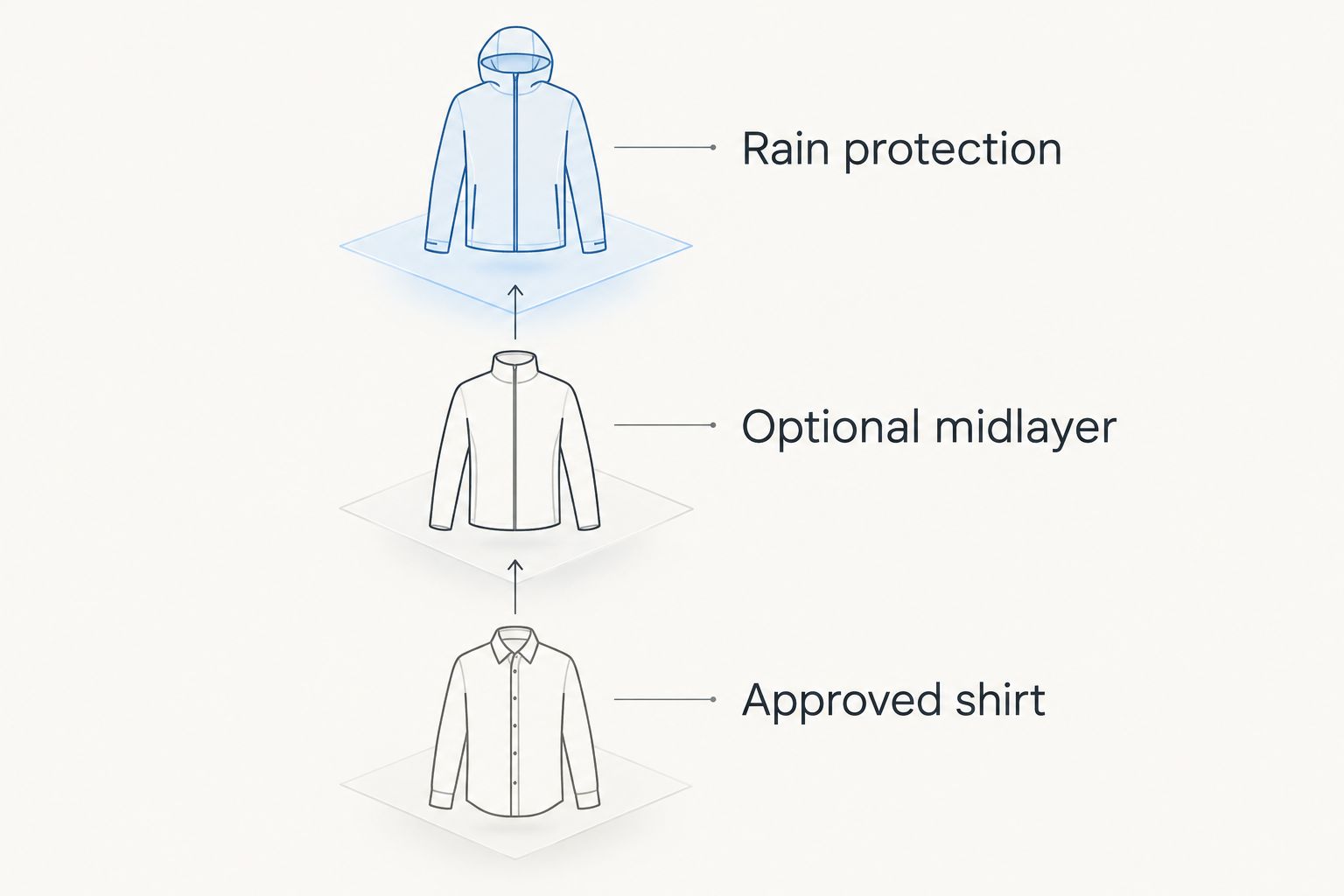
A quarter-zip gives you a layer to add or remove. It does not automatically replace a rain shell, and a heavier garment is not automatically the better choice beneath a carry strap. Test the combined outfit for shoulder movement and decide where the removed layer will go.
Best for an optional midlayer: the Navy Signature Quarter-Zip is a named layering option in the Mac Caddy range. Consider it where the dress code allows that style, but confirm its garment details before relying on it for a particular weather condition. The supplied product description does not establish waterproofing or a temperature rating.
- Check the forecast again before departing for the course.
- Try the midlayer over the shirt you will actually wear.
- Keep rain protection separate unless the garment explicitly provides it.
- Avoid a combination that bunches beneath the carrying strap.
- Choose a practical place to store a removed layer.
If your workwear needs a polo or an optional midlayer, these are two relevant starting points. Choose between them by the wardrobe gap you identified—not because every caddie needs both—and confirm the current garment details before ordering.


Check footwear, headwear, and pocket access
Start with the approved shoes you know fit. Walk in the complete outfit before introducing a new belt, trouser cut, or accessory into a working round. An 18-hole assignment is not the place to discover that a pocket opening sits beneath your bag strap.
Choose headwear according to club rules, fit, and the conditions. A cap covers part of your head; it is not proof of a tested ultraviolet protection rating or complete sun coverage. Keep clothing decisions separate from the rest of your sun-protection plan.
Arrange pockets around actual tasks. You should be able to reach the items you are responsible for carrying without fighting your shirt hem, belt, or bib. Leave unnecessary extras out rather than turning every pocket into storage.
- Check shoes against the employer’s footwear rules.
- Walk on suitable surfaces to assess fit before the assignment.
- Test hat security while looking down and bending.
- Keep frequently used items accessible with the bag in place.
- Remove pocket contents that press against you under load.
Plan the laundry rotation before adding more clothes
Build your 2026 rotation from your work schedule and the care labels, not a generic packing list. Lay out what you own, remove anything that no longer meets the dress code, and identify which pieces are ready for another shift.
A 2-shirt rotation is a useful planning example, not a promise that two shirts cover every schedule. Your actual requirement depends on how often you work, when you can wash, and how each garment must be dried. Add a spare where your schedule demands one.
Read the care instructions before combining garments in a wash. Check collars, seams, and strap-contact areas afterward; a shirt can look presentable on a hanger yet feel rough in the same spot every time you carry.
- Follow each garment’s washing and drying instructions.
- Check that the next work outfit is clean and ready.
- Inspect seams and strap-contact areas for wear.
- Keep a spare approved shirt when your schedule requires one.
- Replace a problem garment for a specific reason, not just its age.
Compare clothing options for caddie work
Choose by assignment, not by category name alone. Each option below solves a different problem, and none replaces approval from the club or event organizer. Use this table to decide what belongs in your 2026 wardrobe before comparing individual garments.
| Option | Best for | Practical advantage | Key limitation |
|---|---|---|---|
| Employer-issued uniform | Assignments requiring a designated uniform | Meets the specified appearance when worn as instructed | Fit and personal style choices depend on what is issued |
| Approved plain polo | Workplaces requiring a restrained appearance | Simple to match with approved trousers or shorts | A plain design says nothing about carrying comfort |
| Approved patterned polo | Clubs allowing individual style | Adds personality without changing the basic collared-shirt format | Pattern and branding can conflict with uniform rules |
| Quarter-zip midlayer | Adding a removable layer over an approved shirt | Lets you adjust your outfit during the shift | Does not establish rain protection or unrestricted shoulder movement |
| Rain shell | Assignments with forecast rain | Provides a separate weather layer when its specifications support that use | Fit, weather claims, and storage still need checking |
| Graphic T-shirt | Off-duty wear or explicitly permitted casual settings | Gives you more room for personal expression | Not a substitute for a required collared shirt |
Do not read “approved” as a permanent status attached to a garment. Approval belongs to the assignment. A shirt accepted at your regular club still needs checking when you work somewhere else.
Common mistakes golf caddies make with apparel
Shopping before asking about the uniform
Buying the outfit first turns a simple policy question into a wardrobe problem. Get the requirements before choosing colors, patterns, or logos. If instructions are unclear, show the supervisor the proposed outfit rather than asking whether something is merely “golf appropriate.”
Testing the shirt without the bag
A shirt can feel excellent while standing and pull across your shoulder once loaded. Test the working setup, not just the garment. Include the bib, belt, pockets, and layer combination you expect to wear; otherwise you are testing a different outfit.
Treating a midlayer as rain gear
A quarter-zip and a rain shell have different jobs. Do not infer weather protection from a sporty name or a polished appearance. Check the stated specifications and plan a separate outer layer when the conditions require one.
Dressing like the golfer instead of the caddie
Your player’s outfit is not the uniform policy. Loud graphics, loose accessories, or casual shirts belong on duty only when permitted. You can keep your personality without making the caddie manager explain the rules twice.
Overpacking without planning access
An extra garment helps only if you can carry it without interfering with work. Decide where it goes after you remove it and how you will reach your essentials. A tidy storage plan beats stuffing a layer somewhere and hoping it stays put.
FAQ
What should a golf caddie wear?
A golf caddie should wear the club’s or event organizer’s required uniform, with approved footwear and weather layers. Where personal clothing is allowed, test the complete outfit while carrying, bending, and reaching.
Can golf caddies wear shorts?
Golf caddies can wear shorts only where the employer or event rules permit them. Confirm the policy for the specific assignment rather than copying what golfers wear at the course.
Is a polo better than a T-shirt for caddie work?
A polo is the appropriate choice when the dress code requires a collared shirt. A T-shirt belongs on duty only when explicitly permitted; neither style guarantees a comfortable fit under a bag strap.
What is the best golf apparel for golf caddies in hot weather?
The best golf apparel for golf caddies in hot weather meets the dress code, allows working movement, and has garment specifications suited to the conditions. Check the fabric information and stated features rather than relying on the word performance.
Should a golf caddie wear a quarter-zip?
A golf caddie should consider a quarter-zip when an approved removable midlayer fits the assignment. Test it over the work shirt and do not treat it as rain protection unless its specifications support that use.
How many work shirts does a golf caddie need?
A golf caddie needs enough approved shirts to cover the work schedule and laundry turnaround. Plan around the actual care instructions and keep a spare when back-to-back assignments make washing impractical.
Can golf caddies wear branded hats and patterned polos?
Golf caddies can wear branded hats and patterned polos only when the relevant uniform policy allows them. Confirm restrictions on visible logos, colors, and patterns before choosing personal apparel.
One last thing
The most useful fitting-room accessory for a caddie is the bag. Before your next shift, put on the complete outfit and perform the movements your job requires. That short rehearsal can expose a problem a mirror cannot: the collar that pulls, the pocket you cannot reach, or the layer that bunches under load.
Once the work requirements are covered, explore Mac Caddy for apparel that adds your personality within the rules. Look sharp, carry comfortably, and leave the unnecessary adjustments for your player’s swing.